
Mooring Pole Management Software: A Guide for Resorts

Ludvik Ludviksson

Mooring pole management software gives resort and hotel properties a dedicated operating environment for pole assignments, bookings, guest records, billing, electricity metering and dock-side communication. For a luxury property where yacht-owning guests are part of the commercial picture, a mooring pole is a revenue line and a brand touchpoint, not a back-office detail. Without the right software, that combination creates admin friction at exactly the moment the guest expects the property to have everything in hand.
Key Takeaways
Mooring poles at resort and hotel properties require dedicated management software. The PMS was not built for pole assignments, vessel records, mooring bookings or dock-side billing.
The right platform connects pole assignment, guest records, bookings, payments and electricity metering in one operational view for the property team.
Mooring revenue from poles, power and ancillary dock services should reach the property P&L as a clean, attributable line, not a side file that finance has to reconcile by hand.
A yacht-owning guest who checks in upstairs expects the same standard at the water. Mooring pole software closes the gap between the polished PMS experience and the dock.
PMS for the room. Harba for the dock. Both systems sit alongside each other; the PMS handles the building, Harba handles the water.
One database for ops and boaters: pole assignment, guest arrival, payment and service records update together, so the front desk and dock team always work from the same picture.
Luxury hotel properties across the Mediterranean, including resort properties in Mykonos, have moved their mooring pole operations from parallel Excel to connected management within a single season.
Mooring poles are a standard feature at many waterfront resort properties, particularly across the Mediterranean and other luxury coastal destinations. A yacht arrives. The crew ties up to the pole. The guest walks to the property. From that moment forward, the experience at the water reflects on the property as much as anything that happens inside it.
For most resort properties, however, the system handling that arrival is nothing like the one handling the room. The PMS knows the guest's name, rate, preferences and history. The dock team has a spreadsheet, a whiteboard or a notebook. Pole availability is tracked by whoever last updated the file. Billing is raised separately, reconciled late and often incomplete.
That gap is what mooring pole management software is built to close.
What mooring pole management involves
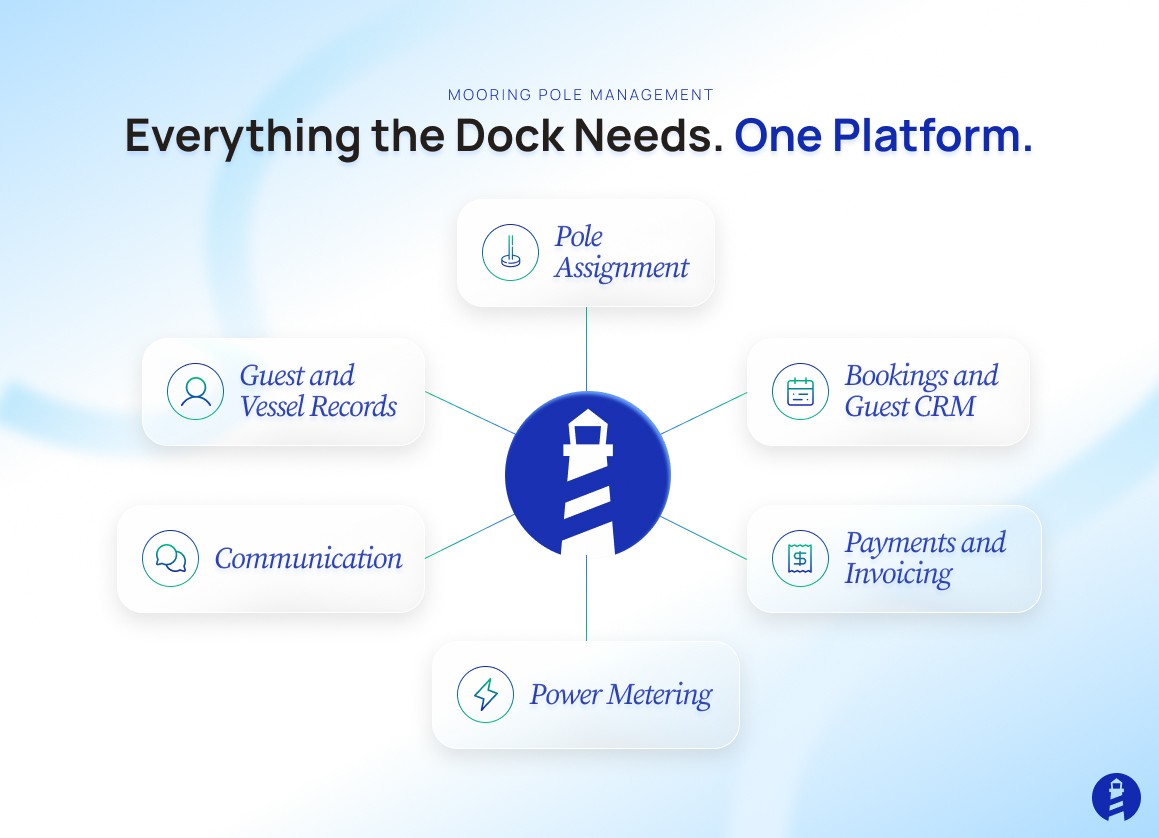
Managing mooring poles at a resort means more than knowing which boat is attached to which pole. It means tracking which poles are available, which bookings are confirmed, which guests have paid, how much electricity is being used, what services have been ordered and what communication needs to reach arriving guests.
At a small property with a few poles, manual processes may hold the operation together for a season. At a resort running twenty or thirty poles during peak season, with yacht-owning guests expecting a consistent experience from water to room, the manual approach creates operational risk at the exact moment the property can least afford it.
The risks are specific. A pole marked available in one file may have a yacht arriving that afternoon, known only to the person who answered the phone. A guest's electricity usage is estimated at checkout rather than metered. A day mooring is used, billed three days late and at the wrong rate. A high-spend guest asks the concierge about their mooring bill and the concierge has to call three people to answer.
Each of these is a recoverable situation in isolation. Together, across a full peak season, they represent revenue leakage, staff pressure and a guest experience that falls short of the standard the property sets everywhere else.
Why the PMS does not cover the poles
Every luxury resort understands operating systems. Opera, Mews, Cloudbeds and chain-specific stacks run the room side of the property with precision: reservations, billing, guest profiles, housekeeping workflow, F&B charges. These tools were built for exactly this purpose.
The dock has no equivalent in the PMS stack. A property management system can hold a guest profile and a room charge. It was not built to track pole availability by vessel size, manage mooring bookings, meter electricity by pedestal, or connect dock-side service orders to the main billing picture.
Extending the PMS to cover the poles is technically possible in some configurations, but in practice it creates workarounds that add admin burden rather than removing it. The dock needs its own operating environment, designed for what actually happens at the water: pole assignment, arrival management, power metering, service requests and invoice generation that connects cleanly to the property P&L.
PMS for the room. Harba for the dock. The two systems sit alongside each other; the PMS handles the building, Harba handles the water. For a property GM, the practical question is not whether the existing stack can be extended to cover the poles. It is whether the dock is currently running at the standard the rest of the property sets, and what the cost is when it is not.
The Excel problem at the mooring
When there is no purpose-built software in place, the most common fallback is a spreadsheet. One file tracks pole assignments. Another tracks payments. A third holds guest contact details. Someone sends booking confirmation emails by hand. Electricity usage is logged manually or estimated at the end of the stay.
This arrangement works until it does not. The moment two bookings overlap, a payment is missed or a high-value guest asks a question the dock team cannot answer immediately, the spreadsheet becomes the visible weak point in the property's guest experience.
The problem is not the spreadsheet itself. The problem is that the dock has become too commercially important, too guest-facing and too operationally complex for disconnected admin to hold it together reliably. When a yacht-owning guest steps off a tender at a Mediterranean resort expecting the same clarity they received at check-in, a file on someone's desktop is not an adequate answer.
From parallel Excel to PMS-grade marine ops in one season: for most resort properties with mooring infrastructure, that transition is shorter than expected, and more operationally straightforward than continuing to run the dock on tools that were never built for it.
What mooring pole management software does
Purpose-built mooring pole management software gives resort teams one shared operational view of everything happening at the water. The core capabilities cover:
Pole assignment and live availability. Property staff can see which poles are occupied, reserved or available without calling the dock or opening a separate file. A visual map of the mooring area makes this immediate and accurate throughout the day.
Bookings and guest management. Arriving yacht guests can confirm a pole in advance. Booking details connect directly to guest profiles, so the front desk and dock team share the same information. Arrivals are expected rather than surprises, and the details the dock team holds match what the concierge already knows.
Payments and invoicing. Pole charges, electricity, services and extras are billed through one system. Invoices are accurate, raised on time and reconciled without manual input from finance. For resort properties, mooring revenue becomes a visible commercial line rather than an approximation produced under pressure at the end of the month.
Electricity and power metering. Where poles carry shore power, smart metering replaces manual readings and estimation. Usage is tracked, billed automatically and available for the guest to review. Disputes and billing errors are reduced significantly.
Guest records and vessel history. Vessel dimensions, contact preferences, prior visits, special service notes and payment history sit in one place. When a returning guest arrives, the dock team has what they need before the guest reaches the pontoon.
Communication and arrival management. Arrival information, payment confirmation, service availability and operational updates reach guests through the platform. The property communicates with clarity rather than through chains of emails and calls that may or may not arrive before the yacht does.
One database for ops and boaters: the same record the dock team updates is the record the front desk sees. Version control problems, parallel files and guests who fall between two systems are removed from the equation.
Revenue: turning poles into a clean P&L line
For a resort property, mooring poles carry real commercial value. A day mooring for a superyacht, a weekly pole booking for a sailing guest, shore power used over four nights, a tender service arranged through the dock: these are all billable items that belong on the property P&L.
In a manual or spreadsheet-based operation, this revenue is difficult to capture cleanly. Some charges are estimated. Some are missed in the daily rhythm of a busy dock. Some are billed late, after the guest has departed. The finance team cannot interrogate dock performance without someone doing manual reconciliation first, and the numbers that emerge are approximate by the time they arrive.
Connected mooring pole software changes the commercial picture directly. Pole assignments connect to billing at the point of arrival. Service orders connect to invoices at the point of request. Electricity usage connects to metered charges at the point of settlement. When the GM asks how the marine amenity performed during August, the answer is available in the reporting layer rather than requiring three days of manual work to produce.
Peter Leonard Marine in England moved from an invoicing process that took days to one that now takes minutes after switching to Harba. For a resort property where peak-season staff time carries real cost, that kind of reduction in back-office workload is both an operational and a commercial improvement.
This is the revenue case for dedicated mooring pole software: not just operational tidiness, but revenue that is fully captured, properly attributed and available for analysis at any point during the season.
Guest experience at the mooring
A yacht-owning resort guest has high expectations. They have just experienced a check-in that felt polished and professional. The front desk knew their name, their preferences and their history. The concierge was prepared.
They expect the same standard at the water.
A pole assignment that requires three calls to confirm. Electricity that is unclear on arrival. A departure payment the dock team cannot explain clearly. Vessel details the dock team does not have. Each of these moments is felt by the guest. For a resort that invests in rooms, restaurants, concierge service and spa to create a consistent experience, the dock is the moment where that investment can be visibly undermined.

Mooring pole management software closes that gap by making the dock ready for the guest before the guest arrives. The pole is confirmed. The arrival is expected. Payment is handled through the same clean digital flow the rest of the property uses. The dock team has vessel details, guest notes and service preferences before the tender ties up.
Luxury hotel properties across the Mediterranean have moved their mooring infrastructure from spreadsheet-based admin to connected management for exactly this reason: the commercial case is real, but the guest experience case is the one that makes the decision immediate.
Power, electricity and ancillary services at the pole
Mooring poles at resort properties often carry shore power: electricity connections that guest yachts use for overnight stays and extended mooring periods. Managing this electricity manually creates consistent problems, including estimated usage, billing disputes, unclear metering and charges that appear on the invoice without adequate explanation for the guest.
HarbaPower gives properties a connected alternative. With smart metering integrated into the core operating environment, electricity usage is tracked by pedestal and connected directly to the guest's billing record. Usage is visible in real time. Billing is automatic. Disputes are reduced because the data is accurate rather than approximate.
Beyond power, the dock typically involves ancillary services: water connections, waste management, tender transfers, fuel coordination, provisioning and security. These services create additional revenue and additional operational complexity. When each sits within the same platform as the pole booking and the guest record, the complexity reduces to one operational view rather than multiple parallel processes.
Harba's Dry Stacks module is relevant for properties that also manage boats out of the water: rack assignments, launches, haul-outs and customer communication all require a dependable operational process. For resort properties expanding their marine amenity, these capabilities form part of the same platform rather than requiring a separate system.
What to look for in a platform
Resort properties with mooring poles have specific requirements that standard dock or harbour operations software may not address well. A platform designed for a commercial port or a municipal marina is not automatically suited to a luxury hospitality environment. The practical considerations worth checking before a decision:
Resort-grade guest workflows. Booking confirmation, arrival management and payment processes should match the standard the rest of the property sets. Self-service options for arriving guests, clean digital communication and card-based or app-based payment should be core features, not optional add-ons.
Billing that connects to the property picture. Pole charges, electricity and dock services should flow through one billing environment that finance can interrogate without manual work. The system should reduce reconciliation burden, not create new versions of it in a different format.
Visual pole and berth mapping. A map-based view of the mooring area is operationally essential for a busy resort dock. Staff need to see availability, bookings and vessel details spatially, not just as a list.
PMS adjacency. The platform does not need to replace Opera, Mews, Cloudbeds or a chain's internal stack. It needs to sit alongside them without conflict, feeding the same commercial picture the property uses to understand overall performance.
Power metering integration. For poles with shore power, automatic metering is worth specifying directly. Manual readings are a consistent source of billing disputes and unnecessary staff overhead.
Data handling and procurement standards. Hotel groups and chain properties will have procurement requirements around data access, permissions, guest information handling and system security. A credible vendor should welcome those questions and answer them clearly.
Where Harba fits
Harba is the operating system for the dock: built for resort and marine-amenity operations, not extended from a tool designed for something else. The HarbaMaster platform covers mooring pole management, berth assignment, guest CRM, invoicing, payments, marina maps and space assignment in one connected environment. HarbaGuest supports yacht guest self-booking and arrival flows from the guest's own device. HarbaPower handles electricity metering, remote control and automatic billing for pole-equipped mooring infrastructure.
For resort properties, the position is straightforward. The PMS runs the room. Harba runs the dock. Both sit in their respective roles, handling what they were built for, without conflict and without duplication. Built for the way luxury hospitality actually runs, Harba sits alongside Opera, Mews, Cloudbeds or a chain's internal stack; the marine amenity and the building operating as one property, not two parallel operations.
Luxury hotel properties with mooring infrastructure, including resort properties in Mykonos, have moved from parallel Excel operations to Harba to give their dock team and front desk one shared picture of every guest, booking, payment and service request at the water. The transition is designed to happen within a single season, without disrupting peak-period operations.
From parallel Excel to PMS-grade marine ops in one season: that is what the move looks like in practice for most resort properties with mooring poles. Operators who want to see the full operational picture before committing can review customer cases and platform guides through the Harba website.
Mooring pole management is part of the luxury guest experience
Mooring poles are not a back-office concern for a luxury resort. They are part of the guest experience from the moment a yacht arrives, part of the revenue picture from the moment the pole is assigned, and part of the brand standard the property works hard to maintain everywhere else.
A spreadsheet, a shared inbox or a disconnected phone process may keep the poles running for a season. It will not keep them running indefinitely as guest expectations rise, ancillary revenue becomes a more significant part of the property's commercial picture and the GM expects the dock to operate at the level the rest of the property has set.
Dedicated mooring pole management software gives resort teams the operating environment the dock deserves: pole assignment, guest management, payment, electricity and service all in one place, visible in real time, and ready for the guest before the guest arrives.
If your property's poles are currently managed in a file that only one person keeps updated, the right time to change that is before peak season exposes the gap. Take the helm and bring the dock up to the standard the rest of the property has already set.
Ready to see how Harba runs mooring poles at luxury resort properties? Download the marine-amenity operations guide for resort GMs and property teams.
Frequently Asked Questions
1. What is mooring pole management software?
Mooring pole management software gives resort and hotel properties a dedicated system for assigning poles, managing bookings, processing payments, metering electricity and tracking yacht-owning guests from first arrival to final bill. It is the operating system for the dock: it handles the water-side operations the PMS was never designed to manage, running alongside Opera, Mews, Cloudbeds or a chain's internal stack.
2. Why do resorts need dedicated software for mooring poles?
A standard property management system was built for rooms, not for vessel berths, mooring poles or dock-side billing workflows. Without dedicated software, mooring pole operations typically run on spreadsheets and manual processes that cannot maintain the operational standard a luxury resort sets for the rest of the guest experience, or capture the commercial value the poles carry.
3. How does mooring pole software sit alongside an existing hotel PMS?
Mooring pole software runs alongside the PMS rather than replacing it. Opera, Mews, Cloudbeds and chain-specific stacks handle the building. A platform like Harba handles the dock. Both operate from their respective purposes, giving the property one complete commercial picture across the building and the water, without one system having to do the job the other was built for.
4. How does mooring pole software improve revenue capture?
Dedicated software connects pole assignments, service orders and electricity usage directly to invoicing at the point of activity. This removes the missed charges, estimated billing and late reconciliation that are common in spreadsheet-based mooring operations, and makes mooring revenue visible and attributable in the property P&L in real time rather than after manual cleanup.
5. What should a luxury resort look for in mooring pole management software?
Look for pole assignment and live availability mapping, yacht guest booking and CRM, digital payment and invoicing, electricity metering, service management and clear data handling standards. The platform should operate to the guest-experience standard the resort sets elsewhere and sit comfortably alongside existing hospitality systems without conflict.
6. How quickly can a resort property move from spreadsheets to dedicated mooring pole software?
For most resort properties, the transition from manual processes to a connected platform takes one season. The rollout should be staged around the most operationally critical workflows first: pole data, guest records, bookings and payment. From parallel Excel to PMS-grade marine ops in one season is the practical outcome for most properties, not an aspirational target.
Related Blogs
More guides for resort and marina operators