
The Hidden Costs of Spreadsheet Dependency at a Resort Marina

Ludvik Ludviksson

The spreadsheet running your resort dock feels free, but it carries hidden costs that grow with every season: berth and shore power revenue that leaks through manual billing, skilled staff hours consumed by reconciliation instead of guest service, a dock guest experience that puts premium rates at risk, and personal and payment data sitting in files that are difficult to control. None of these costs appear on an invoice, which is exactly why they are so easy to keep paying. For a luxury property, the total is usually far larger than the cost of the software that would remove it.
Key Takeaways
Spreadsheet dependency at a resort dock has real costs that never appear on an invoice: lost revenue, wasted staff time, guest experience risk and data exposure.
The largest hidden cost is revenue leakage: berth, mooring and shore power income that manual billing leaves estimated, late or uncaptured across a full season.
A dock experience that does not match the rest of the property puts premium rates and repeat bookings at risk, which is the most expensive hidden cost of all.
Skilled staff hours spent reconciling files, chasing payments and answering avoidable questions are a cost the property pays every peak season, when that time is most valuable.
PMS for the room. Harba for the dock. A resort would never run its rooms on a spreadsheet; the same logic applies to a revenue-generating, guest-facing dock.
The spreadsheet is the most expensive tool in the resort dock, precisely because it appears to cost nothing. It opens on any laptop, every member of staff can use it, and it carried the dock through the property's early years without complaint. That is what makes its true cost so easy to overlook. The costs are real, they compound every season, and they are invisible until someone adds them up.
This is a refreshed look at those hidden costs, written for the resort and hotel property where the dock is a guest-facing, revenue-generating amenity, and where the spreadsheet has quietly become the operating system for the most valuable arrivals of the season.
The Spreadsheet That Runs the Dock Looks Free Because Its Costs Never Appear on an Invoice
The reason spreadsheet dependency persists at resort docks is straightforward: the costs are real but invisible. There is no monthly charge, no licence fee, no line in the budget that reads "Excel dock management." The tool feels free because nothing about it is billed.
What the spreadsheet actually costs shows up elsewhere, disguised as other things. It shows up as berth revenue that was never captured, recorded as revenue the property simply did not earn. It shows up as staff overtime during peak season, recorded as a staffing cost rather than a software gap. It shows up as a guest who did not return, recorded as nothing at all because a lost repeat booking leaves no trace in the accounts.
Because these costs are distributed across revenue, payroll and lost opportunity rather than concentrated in a single invoice, they are almost never attributed to the spreadsheet that causes them. The first step in understanding the true cost of dock spreadsheet dependency is learning to recognise the costs for what they are.
Lost Revenue Is the Largest Hidden Cost, and It Compounds Every Season
The most expensive consequence of spreadsheet dependency is revenue the property earns but never captures. A manual dock operation leaks revenue in predictable, repeating ways.
A day mooring is used by a visiting yacht and never billed, because the dock was busy and the charge was never raised. A departure happens early, before the dock manager is at the desk, and the final charges are estimated below actual usage rather than itemised. Shore power is charged as a round-number guess rather than a metered figure, consistently under-billing what the yacht actually drew. A service ordered through the dock is recorded in one file and forgotten before it reaches an invoice.
Individually these are small. Across a full season at a busy resort dock, they add up to a revenue line the property is effectively giving away. And because a spreadsheet cannot show what it failed to capture, the leak is invisible in the very tool that causes it. The property cannot see the revenue it is losing, because the losing happens in the gaps the spreadsheet does not record.
The fix is timing. When every billable activity connects to an invoice at the point it happens, charges are raised while the detail is still accurate, rather than reconstructed days later once the guest has departed and the exact usage is a matter of memory. Accurate, timely billing is how the revenue leak closes.
A Dock Experience That Does Not Match the Property Puts Premium Rates at Risk
The most expensive hidden cost is also the least visible: the damage a poor dock experience does to the rates and loyalty a luxury property depends on.
A resort commands premium rates by delivering a consistent, high-quality experience across every touchpoint. The spreadsheet breaks that consistency at the water. A yacht-owning guest who receives a polished arrival at reception and then a slow, uncertain, manual experience at the dock has been given a concrete reason to question whether the property is worth its premium. The berth confirmation that took three phone calls. The electricity charge no one could explain. The departure invoice that arrived days late and needed correcting. Each is a small failure, and each is remembered by exactly the guest the property most wants to keep.
The cost of this does not appear in any ledger. A guest who quietly decides not to return leaves no line in the accounts. A referral to another high-spend guest that never happens because the last dock experience was disappointing is invisible by definition. Yet a single repeat booking or referral from a yacht-owning guest can represent more revenue than years of software cost. Guest experience at the dock should match the rest of the property, and when it does not, the property pays in the currency it can least afford to lose: the loyalty of its highest-value guests.
Skilled Staff Hours Disappear into Reconciliation That Produces No Guest Value
The second hidden cost is staff time, and at a luxury resort that time is expensive. A manual dock operation consumes skilled staff hours on work that creates no guest value: updating the berth spreadsheet, reconciling which version is current, chasing payments after departure, raising invoices by hand, and answering questions that a connected system would answer instantly.
This cost peaks at exactly the wrong moment. During the peak season, when staff time is most valuable and most scarce, the manual overhead is at its heaviest. The dock manager who should be welcoming a high-spend arrival is at a desk reconciling a berth sheet. The front desk that should be handling a concierge request is on the phone to the dock asking which berth is free. The property is paying premium-season wages for administrative reconciliation that a system would eliminate.
Oban Marina in Scotland reduced vessel check-in time from 20–30 minutes per vessel to under 5 minutes after moving to Harba, and eliminated the need for a dedicated reception desk during peak season. That is the hidden staff cost made visible and then removed: faster check-in, and an entire reception function taken out of the peak-season cost base. For a resort, the same saving appears as staff hours returned from reconciliation to the guest-facing service the property is actually known for.
Guest and Payment Data in Spreadsheets Is Difficult to Control, and That Is a Growing Compliance Cost
A hidden cost that has grown more serious since this topic was first worth writing about is data exposure. A resort dock spreadsheet typically holds personal data, vessel details, contact information and payment-related records. Held in shared files, that data is difficult to control.
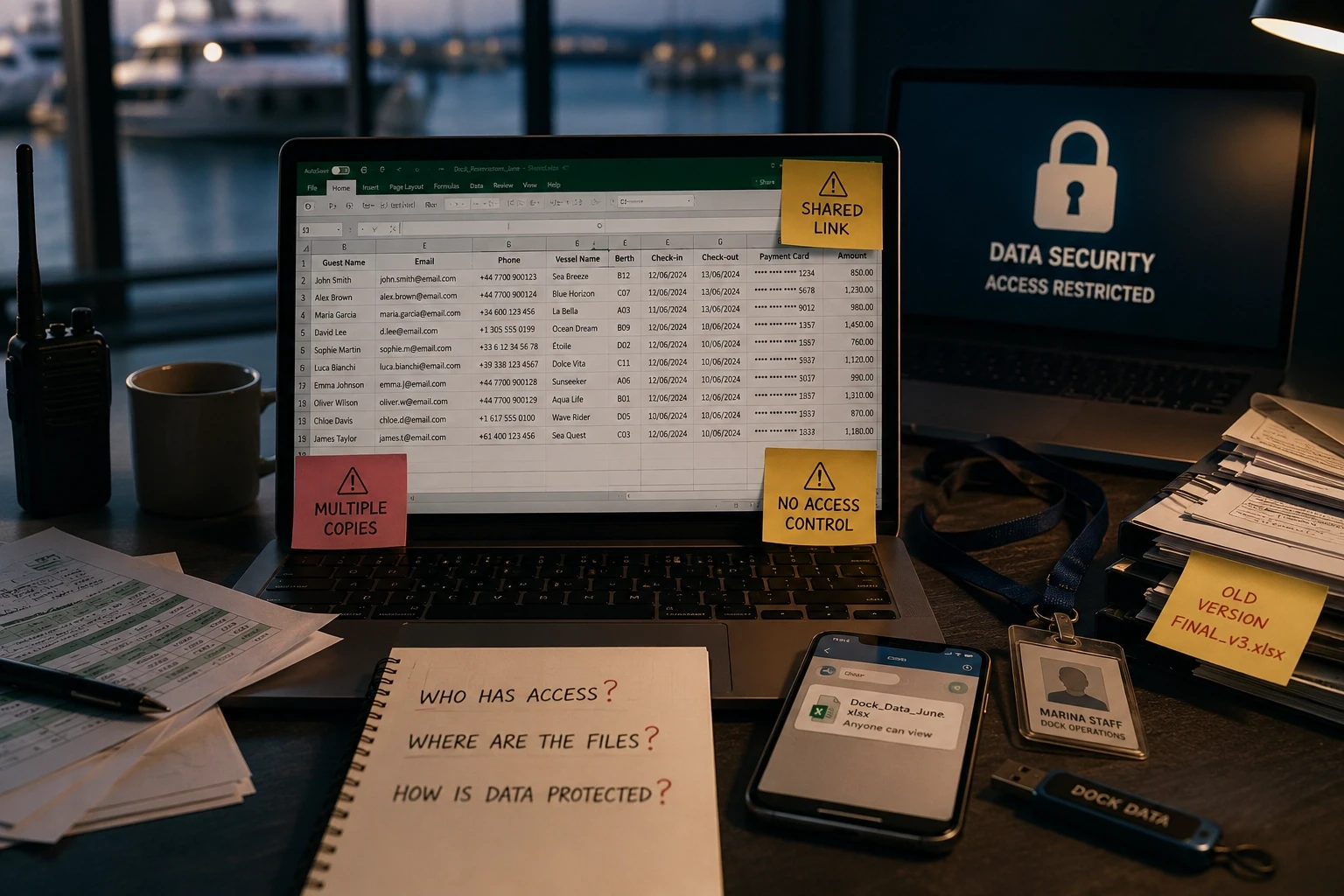
Multiple copies exist. It is unclear who has access. Version control is informal at best. A file sits on a departed staff member's laptop. Payment details are recorded in a document anyone with the link can open.
The cost here is partly the risk itself and partly the difficulty of answering basic procurement questions. Who can access guest data at the dock? What happens to the records when a staff member leaves? How is payment information protected? A spreadsheet cannot answer these questions well. A connected system with proper access controls and a single source of record can. As data-protection scrutiny rises across European hospitality, the informal spreadsheet becomes a liability the property carries without pricing it.
Why the Costs Stay Hidden: the Spreadsheet Cannot Report on What It Fails to Do
The reason all of these costs remain hidden comes down to a single structural fact: a spreadsheet cannot report on its own failures. It records what is entered into it. It is silent about everything that was missed, estimated, forgotten or lost in a handover between files.
This is where the difference between disconnected files and one database for ops and boaters becomes concrete. When the dock team, front desk and finance each work from a separate file, no single view exists of what the dock actually earned, what it failed to capture, or where the time went. The costs are spread across three versions of the truth and never reconciled into one honest picture.
A single operational record makes the previously hidden costs visible, and in making them visible, removes them. Every booking, check-in, payment and service request updates one record that the dock team, finance and the guest all work from. The charge that would have been missed is captured, because it lives in the same system that produces the invoice. The revenue the spreadsheet could never show is finally visible, because there is one place where the whole picture exists. Harba's HarbaMaster platform and HarbaGuest tools are built on this single-database model, which is why the operational record and the guest journey stay in step.
PMS for the Room, Harba for the Dock: No Resort Would Run Its Rooms on a Spreadsheet
The clearest way to see the true cost of dock spreadsheet dependency is to ask a simple question: would the property ever run its rooms this way?
No luxury resort manages its rooms on a spreadsheet. The room operation is too valuable, too guest-facing and too revenue-critical to run without a dedicated system, and no GM would suggest otherwise. The investment in Opera, Mews, Cloudbeds or a chain's internal stack was never in doubt, because the cost of not having it is obvious.
The dock is the same kind of operation, carrying the same kinds of hidden cost, and the same logic applies. PMS for the room. Harba for the dock. Harba sits alongside the PMS, running the water the way the PMS runs the building. The property already accepted this reasoning once, for the room. The hidden costs of the dock spreadsheet are the same argument, applied to the part of the property that has been left on manual tools for too long. From parallel Excel to PMS-grade marine ops in one season: that is how the hidden costs come off the books.
Adding Up the Hidden Costs Usually Makes the Decision Obvious
When a resort finally puts the hidden costs of its dock spreadsheet on one page, the decision tends to make itself.
The lost revenue from estimated, late and missed billing, estimated from the property's own dock activity. The staff hours consumed by reconciliation, priced at peak-season rates. The guest experience risk to premium bookings, harder to price but impossible to ignore once named. The data exposure that procurement and legal would rather not carry. Set against the annual cost of a platform built to remove all four, the comparison is rarely close.
A luxury hotel property in Mykonos moved its dock off Excel to Harba within a single season, closing the hidden costs the spreadsheet had been quietly carrying and giving the property one connected picture of dock revenue and guest activity. For a resort weighing the same move, the useful question is what the spreadsheet has been costing all along, in revenue not captured, time not spent on guests, rates put at risk and data left exposed.
The spreadsheet was never free. It was simply never billed. Take the helm and take the hidden costs off the books before another season adds to them.
Ready to put a number on what your dock spreadsheet is costing? Download the marine-amenity operations guide for resort GMs and finance directors.
Frequently Asked Questions
1. What are the hidden costs of running a resort dock on a spreadsheet?
Four main costs, none of which appear on an invoice: lost revenue from berth, mooring and shore power billing that is estimated, late or missed; skilled staff hours consumed by reconciliation and manual admin; guest experience risk that threatens premium rates and repeat bookings; and data exposure from guest and payment records held in files that are difficult to control. For most resort properties, the total can far exceed the cost of dedicated software.
2. Why is lost revenue the largest hidden cost of a dock spreadsheet?
Because a manual operation leaks revenue in small, repeating ways that add up across a season: unbilled day moorings, estimated departures, under-billed shore power and forgotten service charges. A spreadsheet cannot show what it failed to capture, so the leak is invisible in the very tool that causes it. The property loses the revenue without ever seeing it go.
3. How much staff time does spreadsheet dependency actually cost?
The cost peaks in peak season, when staff time is most valuable. Hours go into updating files, reconciling versions, chasing payments and answering questions a connected system would answer instantly. Oban Marina reduced vessel check-in from 20–30 minutes per vessel to under 5 minutes and removed the need for a dedicated peak-season reception desk. For a resort, that is skilled staff time returned from admin to guest service.
4. How does a dock spreadsheet put premium rates at risk?
A luxury resort charges premium rates by delivering a consistent experience everywhere. A slow, manual, uncertain dock experience breaks that consistency for exactly the high-spend yacht-owning guests the property most wants to keep. A lost repeat booking or referral leaves no trace in the accounts, but it can represent more revenue than years of software cost. It is the most expensive hidden cost because it is the least visible.
5. Is keeping guest and payment data in spreadsheets a compliance risk?
It is a growing one. Shared spreadsheets make access and version control difficult: multiple copies, unclear ownership, files on departed staff laptops, payment details in openable documents. A connected system keeps guest, vessel and payment records in one controlled place with defined access, which is a materially stronger position when procurement or legal asks who can reach guest data and what happens to it when a staff member leaves. As data-protection scrutiny rises across European hospitality under GDPR, that gap matters more each season.
6. How does moving off the spreadsheet remove these hidden costs?
By replacing separate files with one database for ops and boaters, where every booking, payment and service request updates a single record. The revenue that would have leaked is captured because it lives in the same system that invoices it. Staff stop reconciling versions. Guests get a dock experience that matches the property. Data sits in one controlled place. From parallel Excel to PMS-grade marine ops in one season is the practical timeline for taking the hidden costs off the books.
Related Blogs
More guides for resort and marina operators