
How to Manage Mooring Infrastructure Alongside a Hotel Property Management System (PMS)

Ludvik Ludviksson
Sep 23th, 2024
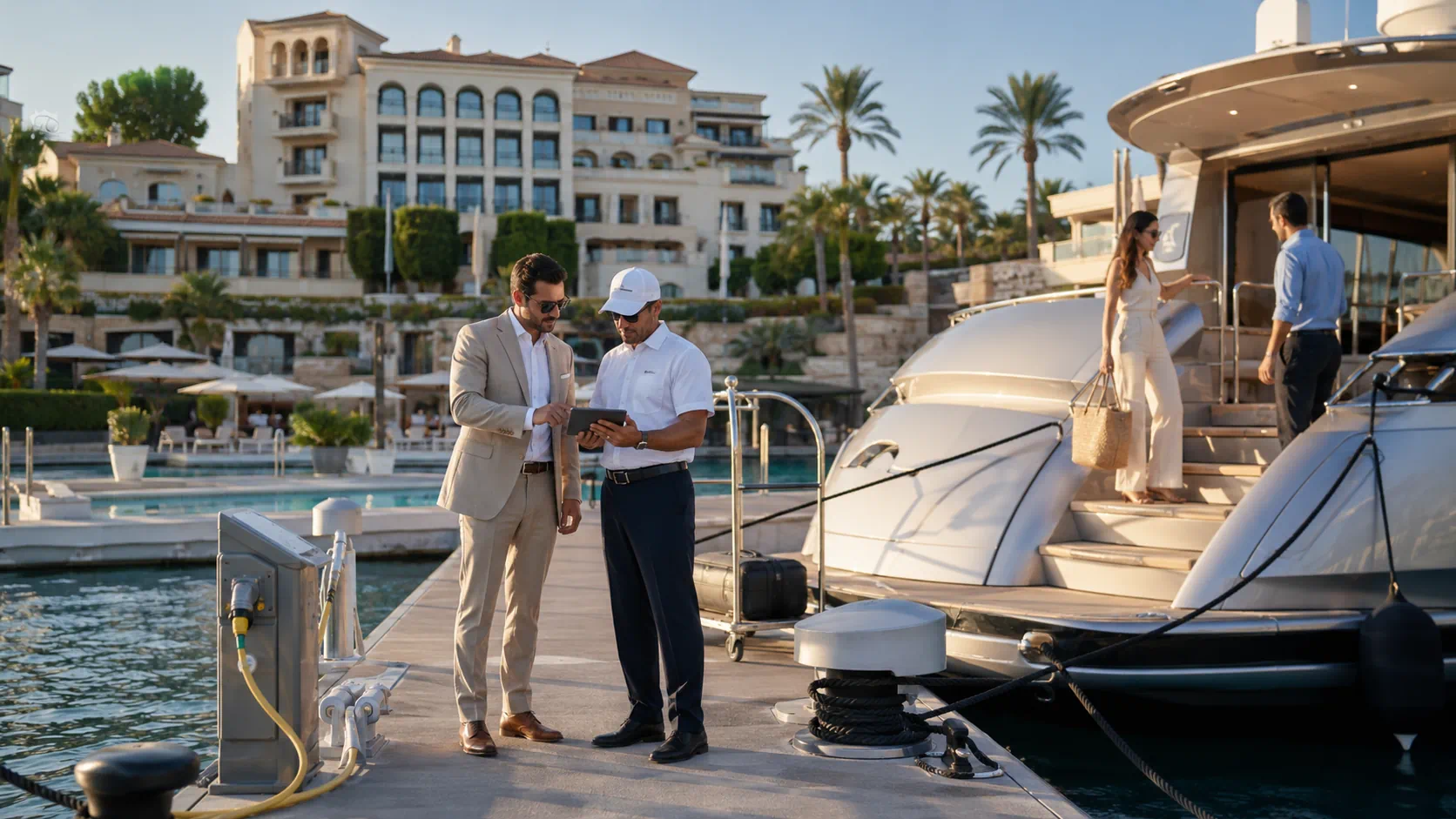
Managing mooring infrastructure alongside a hotel property management system (PMS) means running two purpose-built systems in parallel, each owning the domain it was designed for: the PMS runs the building, and a dedicated marine-amenity platform runs the dock. The two operate side by side rather than one inside the other, because a property management system (PMS) was never built to manage berths, moorings, vessels or shore power. This guide sets out what each system should own, where the practical handover between them sits, and how a resort keeps the dock operating to the same standard as the room without forcing the PMS to do a job it was not designed for.
Key Takeaways
A hotel PMS and a mooring management platform are two different systems for two different domains: the PMS owns the building, the marine platform owns the dock. They run side by side, not one inside the other.
A PMS cannot manage mooring infrastructure well because it was built for rooms: reservations, room billing and housekeeping, not berths, vessels, shore power or dock-side service.
The practical model is clear ownership: the PMS holds the room stay and room folio; the marine platform holds berth and mooring assignment, vessel records, dock payments and shore power.
The handover point between the two systems should be defined deliberately, so a guest who is both a room guest and a yacht guest is served consistently by both teams.
PMS for the room. Harba for the dock. Running the dock on a dedicated platform alongside the PMS is how a resort avoids both the spreadsheet and the failed attempt to stretch the PMS over the water.
One database for ops and boaters keeps the dock side internally consistent, so the dock team, front desk and finance work from one marine record rather than several files.
A growing number of luxury resorts and waterfront hotels face the same systems question. The property runs beautifully on its property management system (PMS). Then it adds, or rediscovers, a marina: a set of berths, a row of mooring poles, a stretch of dock where guests arrive by yacht. The immediate instinct is to make the PMS handle it. That instinct is understandable, and it is almost always the wrong starting point. This guide explains why, and sets out the model that actually works.
The First Instinct Is to Stretch the PMS Over the Dock, and That Is Where the Trouble Starts
When a resort with a property management system (PMS) turns its attention to the marina, the first question is usually whether the existing system can absorb it. The property already pays for Opera, Mews, Cloudbeds or a chain stack. The team knows it. Adding another system feels like duplication. So the instinct is to stretch the PMS over the dock.
The trouble starts almost immediately. A PMS models a room: a room has a rate, an occupancy, a folio and a housekeeping status. A berth is a different object. It has a length and a beam limit, a vessel attached to it with its own dimensions and draft, a power pedestal, a booking that may be hourly or seasonal, and a guest who may or may not also be staying in a room. The PMS has no native concept for any of this, so the team improvises: a custom field here, a workaround there, a spreadsheet alongside for everything the property management system (PMS) cannot hold.
Within a season, the stretched PMS has become the same thing the property was trying to avoid: a manual, workaround-heavy process that does not actually run the dock, it just records fragments of it. The lesson most properties learn the hard way is that the dock needs its own system, designed for the water, running alongside the PMS rather than inside it.
The PMS Owns the Building and the Marine Platform Owns the Dock: Clear Domains Are the Whole Point
The model that works is division of ownership. Each system owns the domain it was built for, and the boundary between them is drawn deliberately rather than left to improvisation.
The PMS owns the building. It holds the room reservation, the room rate, the guest folio for the stay, housekeeping, and the F&B and spa charges that post to the room. This is what it was designed to do, and it does it well.
The marine platform owns the dock. It holds berth and mooring assignment, vessel records with dimensions and draft, the mooring booking whether hourly, nightly or seasonal, shore power metering, dock-side service orders and the marine invoice. This is what a property management system (PMS) was never designed to do, and what a dedicated platform like Harba is built for.
When each system owns its domain cleanly, neither is asked to do a job it was not built for. The PMS is not cluttered with custom fields trying to approximate a berth. The dock is not run from a spreadsheet bolted to the side of the PMS. Each operates at full strength in its own domain, which is the entire point of running them side by side.
A Guest Who Is Both a Room Guest and a Yacht Guest Is Where the Two Systems Must Be Coordinated
The one place the two domains genuinely meet is the guest who is both staying in a room and mooring a vessel. This is the coordination point that a resort has to handle deliberately, because it is where a poorly-managed boundary becomes visible to exactly the high-value guest the property most wants to impress.
Consider a guest who books a suite for a week and brings a yacht that needs a berth for the same period. The room side is handled by the property management system (PMS). The berth, the vessel details, the shore power and any dock-side service are handled by the marine platform. The guest experiences one stay, so the two teams need to serve them as one property even though two systems are involved.
The practical answer is a defined handover, not a technical merge. The front desk knows the guest has a berth because the dock team has recorded it in the marine platform and the two teams communicate around the arrival. The concierge can answer a mooring question because the dock information exists in a system someone can actually consult, rather than in one person's memory. Whether the marine charges are settled separately at the dock or consolidated onto the room folio is a commercial decision each property makes, and it should be made explicitly rather than by default. The goal is a guest who feels served by one property, supported by two systems each doing their job.
Keeping the Dock Side Internally Consistent Matters as Much as the PMS Boundary
While the property management system (PMS) boundary gets the attention, the more common failure is internal inconsistency on the dock side itself, where the marine operation is split across several files and no single record is authoritative.
A resort can define a clean PMS boundary and still run the dock badly if the marine side is itself fragmented: berth assignments in one spreadsheet, payments in another, vessel details in a third, shore power in a notebook. The boundary with the PMS is not the problem in that case. The problem is that the dock has no single source of truth of its own.
This is where one database for ops and boaters matters. On the marine side, every berth assignment, booking, payment and service request should update one record that the dock team, the front desk and finance all work from. Sønderborg Marina in Denmark manages multiple harbours from a single platform, with consistent visibility across guests, residents, invoices and communications, which is the same internal consistency a resort dock needs even at a single site. When the dock side is internally coherent, the handover to the PMS is simple, because there is one clear marine record to coordinate with rather than several competing versions.
Payments and Shore Power Are Where a Dedicated Platform Most Clearly Beats a Stretched PMS
Two areas show most clearly why the dock needs its own system rather than a corner of the property management system (PMS): guest payments at the dock, and shore power.
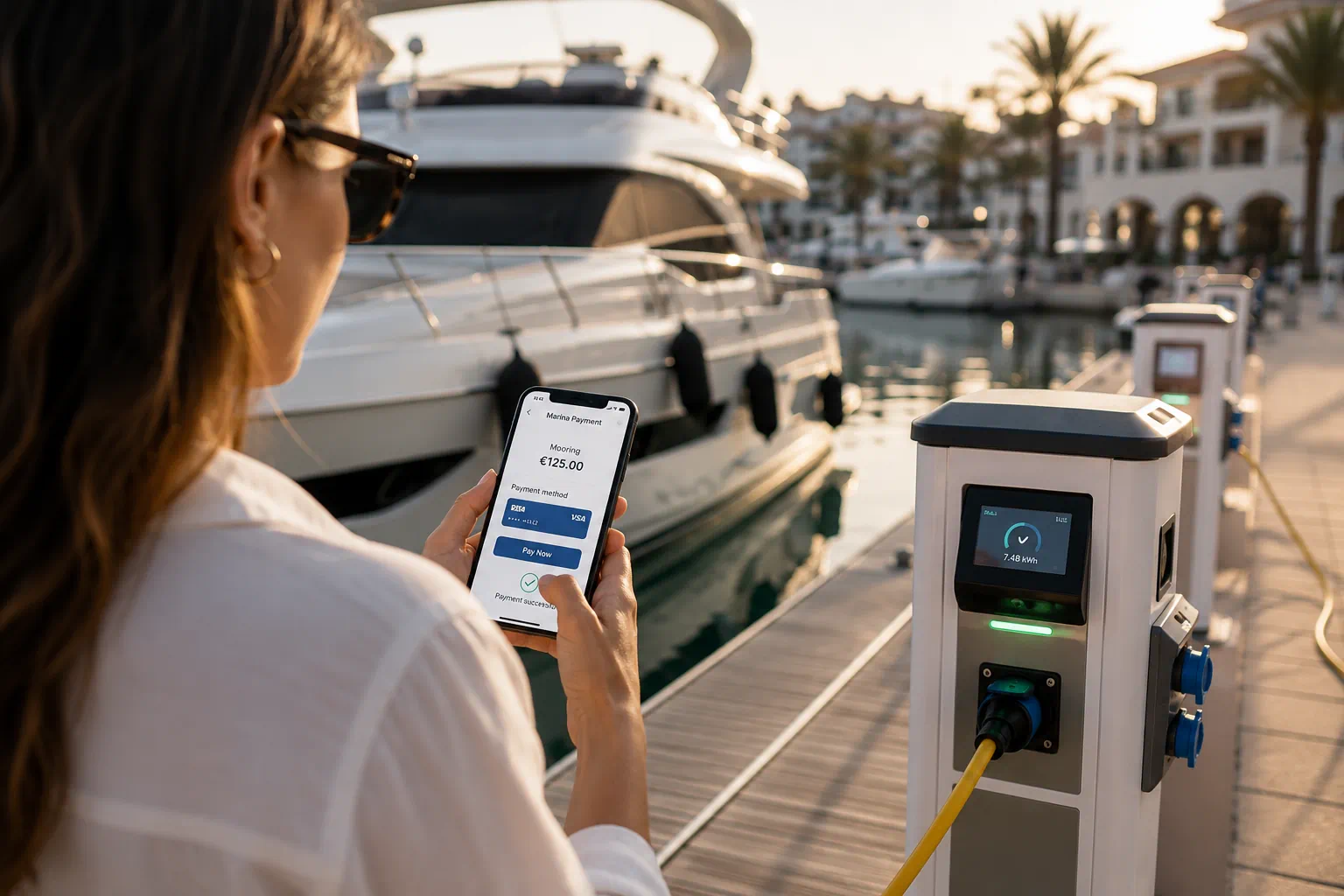
Dock payments have their own rhythm. A visiting yacht may pay on arrival or departure, by card, by app, or against a seasonal contract. A dedicated marine platform handles these flows natively. Sejlforeningen Vikingen in Denmark moved from cash-based operations to a fully cashless digital model, with payments, invoicing and member communication handled in one connected system, which is the kind of clean digital payment flow a resort dock needs and a stretched PMS cannot provide for vessels. HarbaGuest supports yacht guest self-booking and digital payment from the guest's own device, so the dock transaction is as smooth as the rest of the property.
Shore power is the clearest example of all. A PMS has no concept of electricity metered by pedestal. Managed manually, shore power is estimated and routinely under-billed. HarbaPower meters electricity by pedestal and connects it automatically to the guest's marine billing record, so the property bills what it actually supplied. These are dock-domain problems that a room-management system was never going to solve, and they are exactly what a dedicated platform running alongside the PMS is for.
Data Ownership and Access Should Be Defined Across Both Systems, Not Left to the Spreadsheet in Between
Running two systems raises a data question that a resort should answer deliberately, because guest and payment data will exist on both the room side and the dock side, and the weakest point is usually the informal file bridging them.
When the dock runs on a spreadsheet alongside the property management system (PMS), guest and payment data ends up copied into an informal file that sits outside both systems' access controls. That file is the real data-protection exposure: multiple copies, unclear ownership, no access log. Under GDPR, a hotel group is right to treat that informal bridge as a liability.
A dedicated marine platform removes the informal file by giving the dock side its own controlled system with proper access permissions, the same way the PMS controls the room side. Guest and vessel data on the dock lives in one system with defined access, not in a shared spreadsheet anyone can open. For a chain property answering procurement and legal questions about where guest data lives and who can reach it, being able to point to two controlled systems rather than two systems plus an uncontrolled spreadsheet is a materially stronger position.
PMS for the Room, Harba for the Dock: Two Purpose-Built Systems Beat One Stretched System Every Time
The whole approach comes down to a principle that a resort GM already applies everywhere else on the property: use the system built for the job.
The property does not run its restaurant on the property management system (PMS), or its spa on a spreadsheet. Each significant operation runs on a system designed for it. The dock is no different. It is a guest-facing, revenue-generating operation with its own objects, rhythms and requirements, and it deserves a system built for it, running alongside the PMS rather than crammed inside it.
PMS for the room. Harba for the dock. Harba is the operating system for the dock, and it sits alongside Opera, Mews, Cloudbeds or a chain's internal stack, each system owning its domain. That is how a resort avoids both failure modes: the spreadsheet that cannot run the dock, and the stretched PMS that cannot either. From parallel Excel to PMS-grade marine ops in one season: the destination is two strong systems working side by side, not one system doing two jobs badly.
The Right Way to Add a Marina to a Hotel Is to Give the Dock Its Own System from the Start
For a resort adding or formalising mooring infrastructure, the practical conclusion is to skip the stretched-PMS phase entirely and give the dock its own system from the beginning.
The properties that struggle are the ones that try to make the property management system (PMS) cover the water, discover its limits over a difficult season, fall back on spreadsheets to fill the gaps, and eventually adopt a dedicated platform anyway, having paid the cost of the detour. The properties that move smoothly are the ones that recognise from the start that the dock is a distinct domain and give it a distinct system, coordinated with the PMS through a clear handover rather than a forced merge.
A luxury hotel property in Mykonos runs its mooring operation on Harba alongside its existing property systems, keeping the dock in step with the rest of the property. For a resort planning its own marine amenity, the model is the same: define what the PMS owns, define what the marine platform owns, design the handover for the guest who touches both, and let each system do the job it was built for.
Take the helm and give the dock the system it deserves, running alongside the one that already runs your rooms.
Ready to see how the dock runs alongside your hotel PMS? Download the marine-amenity operations guide for resort GMs and operations directors.
Frequently Asked Questions
1. Can a hotel PMS manage mooring infrastructure on its own?
Not well. A property management system (PMS) is built for rooms: reservations, room billing, guest folios and housekeeping. Mooring infrastructure involves berths and moorings with size limits, vessel records, hourly-to-seasonal bookings, shore power metering and dock-side service, none of which a PMS models natively. Properties that try to stretch the PMS over the dock end up with custom workarounds and a spreadsheet alongside, which is the situation a dedicated marine platform is designed to replace.
2. How do a hotel PMS and a mooring management platform work together?
They run side by side, each owning its domain. The property management system (PMS) owns the room stay, room folio and building operations. The marine platform owns berth and mooring assignment, vessel records, dock payments and shore power. The two are coordinated through a defined handover, most importantly for a guest who is both a room guest and a yacht guest, so both teams serve that guest as one property.
3. Should marine charges go on the room folio or be billed separately?
That is a commercial decision each property makes, and it should be made deliberately rather than by default. Some properties consolidate marine charges onto the room folio for a guest staying in both; others settle dock charges separately at the marina. The important thing is that the dock charges are captured accurately in the marine platform first, so that wherever they are ultimately settled, they are complete and correct.
4. What is the risk of running the dock on a spreadsheet next to the PMS?
The spreadsheet becomes an uncontrolled bridge between the two domains. Guest and payment data gets copied into a file that sits outside both systems' access controls, which is a data-protection exposure under GDPR. Operationally, the dock has no single source of truth, so revenue leaks and staff spend time reconciling versions.
5. Does adding a dedicated marina platform mean replacing the PMS?
No. A marine platform sits alongside the property management system (PMS) and does not replace it. The PMS continues to run the building exactly as before. The marine platform takes on the dock, which the PMS was never designed to handle. The property gains a system built for the water without changing the system that runs the rooms.
6. How long does it take to set up a marine platform alongside an existing PMS?
For most resort properties, the dock can be brought onto a dedicated platform within one season. The rollout is staged around the most critical marine workflows first: berth and mooring data, vessel and guest records, bookings and payment. From parallel Excel to PMS-grade marine ops in one season is the practical timeline, with the handover to the property management system (PMS) defined as part of the setup.
Related Blogs
Discover the Powerful Features That Make Sonata the Ultimate SaaS Solution for Scaling Your Business


