
Hotel Marina Management: A Practical Guide for Hotel GMs

Ludvik Ludviksson

Hotel marina management is the operational, commercial and guest-experience framework for running a marina or waterfront dock as an integral part of a luxury hotel property. When a hotel offers berths, mooring facilities or a small marina as an amenity, the dock sits alongside the room, the restaurant and the spa in the guest experience. Unlike those areas, it is rarely supported by a purpose-built operating system. The result is a gap the PMS cannot fill, and a commercial asset that most hotel properties are not yet running at the standard the rest of the property demands.
Key Takeaways
Hotel marina management covers berth allocation, guest bookings, vessel records, payments, electricity metering, staff workflow and reporting across the dock as a formal hotel amenity.
The PMS manages rooms, not berths. Dedicated marine-amenity management software fills the gap between a hotel's polished operational standards and what actually happens at the dock.
A hotel marina is a revenue center: berth income, electricity, ancillary services and day moorings all carry real P&L value when the operations behind them are managed properly.
Yacht-owning hotel guests and visiting boaters expect the same service standard at the marina that the hotel delivers everywhere else. When the dock runs on a spreadsheet, that expectation is consistently at risk.
PMS for the room. Harba for the dock. Both systems sit alongside each other; each handling what they were built for, on the same property, without conflict.
One database for ops and boaters: when the front desk and dock team share the same operational record, guest experience and revenue capture both improve at once.
Hotel marinas across Europe, including luxury hotel properties in Mykonos, are running from connected management platforms rather than spreadsheets and disconnected manual processes.
A hotel with marina access is a different kind of property. It attracts a guest who arrives by sea as well as by road, who values waterfront access as part of the stay, and who measures the quality of every interaction against the standard the property sets in the room. Managing that experience well, and capturing its commercial value accurately, requires more than the tools most hotel operations teams currently have in place.
What hotel marina management involves
Running a marina as part of a hotel operation means managing several interconnected layers at the same time. The physical layer covers berths, pontoons, mooring positions, shore access and electrical infrastructure. The operational layer covers bookings, arrivals, berth assignment, vessel records and staff coordination. The commercial layer involves pricing, billing, electricity metering, service charges and reporting. The guest experience layer covers communication, arrival management, service delivery and the quality of every interaction at the water.
For a standalone marina, these layers are handled by specialist tools and specialist staff. For a hotel marina, they sit inside a property where the primary operating systems were designed for rooms, not for boats. The dock team manages the water side. The hotel team manages the building. The challenge is that both operations need to share information, share commercial data and deliver a consistent guest experience, without systems built to make that straightforward.
The answer is not to extend the PMS. The answer is a purpose-built operating environment for the dock that sits alongside the PMS and handles what the PMS was never designed to manage.
When the PMS stops at the lobby
Every hotel GM understands what a property management system is built to do. Opera, Mews, Cloudbeds and chain-specific stacks manage reservations, billing, guest profiles, housekeeping workflow and F&B charges with precision. These platforms were designed for hotel operations and they handle them well.
The marina sits outside that design. A PMS can hold a guest profile and a room charge. It was not built to track berth availability by vessel dimension, manage mooring bookings across a full season, meter shore electricity by pedestal, coordinate dock staff around arriving yachts or connect boat-side service requests to the hotel invoice.
The gap is usually filled by the same tool that fills most unexplained operational gaps in hotel management: Excel. A dock manager keeps a spreadsheet of berth assignments. A second file tracks deposits and payments. A third lists vessel details. Booking confirmations go out from a shared email inbox. Electricity is estimated at checkout. Finance reconciles at the end of the month, usually with the dock manager's help, usually after a conversation about which version of the file is current.
That process holds the marina together until the operation grows, a key staff member leaves, peak season arrives with more bookings than the spreadsheet can hold, or a high-value guest asks a direct question about their bill that nobody can answer without calling three people.
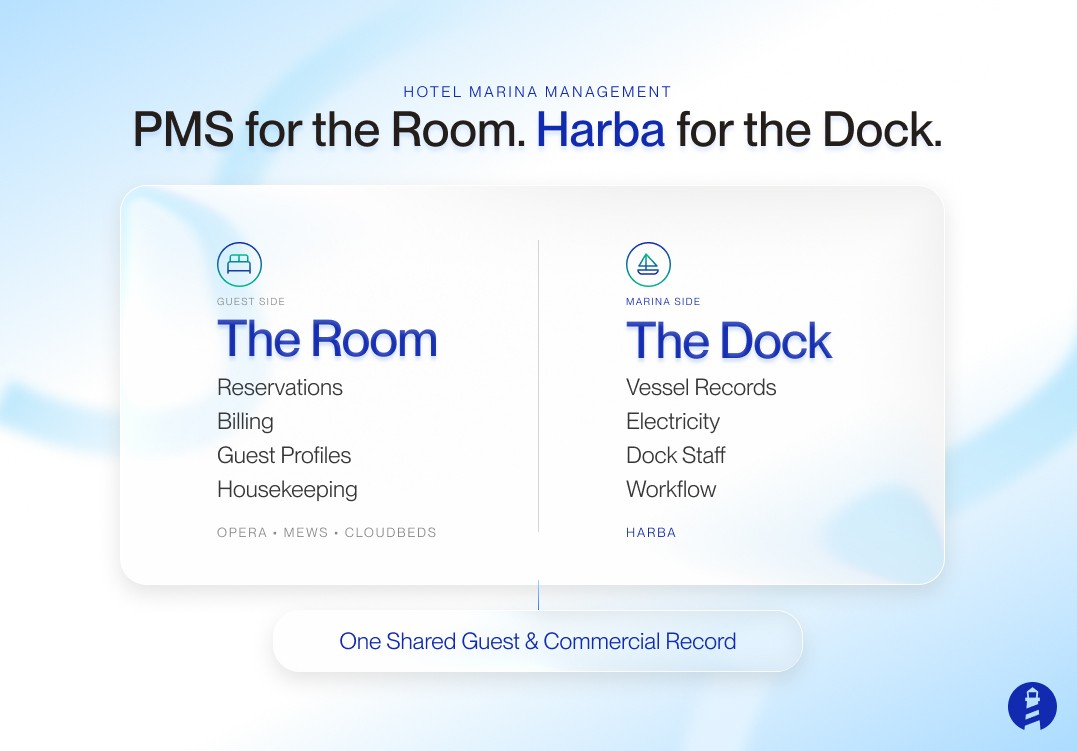
PMS for the room. Harba for the dock. The operating system for the dock sits alongside Opera, Mews, Cloudbeds or a chain's internal stack and does for the water what the PMS does for the building. Purpose-built for the marine side of the property, designed for the way luxury hospitality actually runs.
The two guest types at a hotel marina
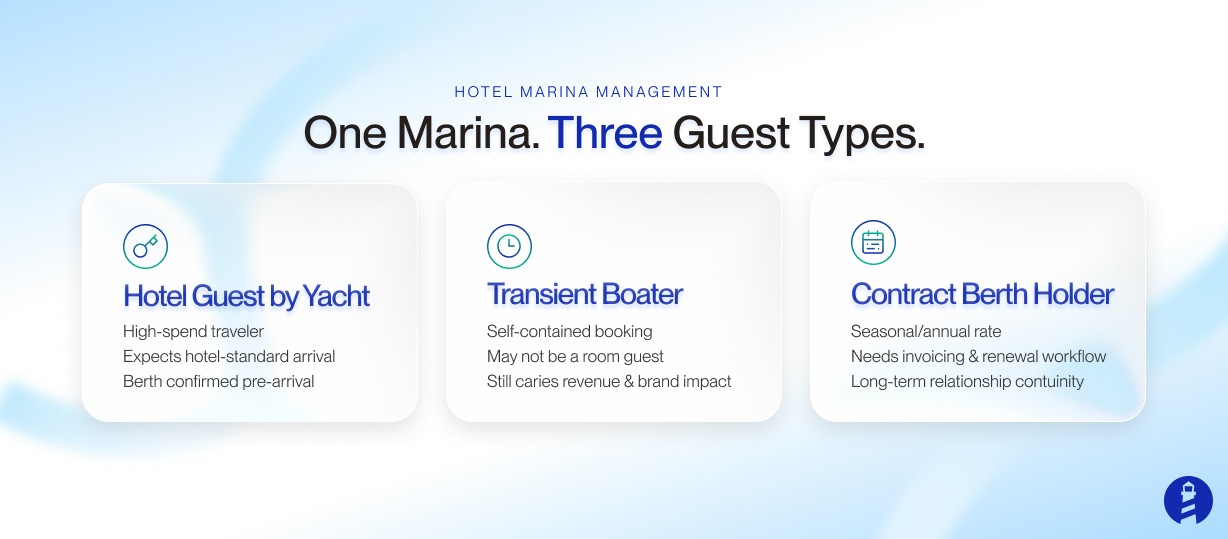
Hotel marinas typically serve two distinct guest profiles, each with different operational needs.
The first is the hotel guest who arrives by yacht. This is often the guest the property values most: a high-spend traveler who chose the hotel specifically because it offers secure mooring for a vessel that represents significant personal investment. This guest expects the marina experience to match the hotel experience. They want berth confirmation before arrival, a polished arrival at the dock, clear payment, reliable power and the kind of proactive service that makes the property worth returning to.
The second is the transient boater: a visiting yacht owner or sailing crew who books a berth to use the hotel's facilities, restaurant or geographic location. This guest may or may not be a hotel room guest. The berth transaction is self-contained, but it still carries revenue implications, service expectations and brand implications for the property.
Many hotel marinas also hold a smaller number of contract berth holders: vessel owners who pay a seasonal or annual rate for a dedicated berth. These accounts require invoicing workflows, renewal management and relationship continuity that is separate from the transient booking flow.
Managing all three guest types from a single spreadsheet, or across several disconnected systems, creates version-control problems that appear at the worst possible moment: when a contract berth holder's vessel is expected and the berth has been allocated to a transient booking, when two visiting boats reference the same position, or when a hotel guest asks the concierge about their mooring charge and the concierge has no reliable system to consult.
One database for ops and boaters: the same operational record the dock team updates is the one the front desk, the concierge and the finance team can access in real time. When a booking is confirmed, a payment received or a berth reassigned, every part of the property sees it at once.
Running the hotel marina as a revenue center
A hotel marina is not just an amenity. It is a commercial asset with multiple revenue streams: berth rental income, shore power charges, ancillary services, day moorings, event-related mooring bookings and potentially fuel or provisioning revenue depending on the property's scope.
For many hotels, this revenue is poorly captured. Berth income may be tracked in one place, electricity estimated in another, service charges forgotten or raised informally at checkout. The finance team cannot interrogate marina performance without a manual reconciliation exercise. The GM's view of ancillary revenue from the water is approximate at best.
Connected hotel marina management software changes the commercial picture directly. Berth bookings connect to billing at the point of confirmation. Electricity connects to metered charges at the point of settlement. Service orders connect to invoices at the point of request. When the GM asks how the marina performed during peak season, the answer is available in the reporting layer, not in a conversation with the dock manager.
Peter Leonard Marine in England moved from an invoicing process that took days to one that now takes minutes after switching to Harba. For a hotel property where marina revenue is expected to appear cleanly in the P&L alongside F&B, spa and events, that kind of operational improvement has a direct commercial value that the finance team will notice.
The principle that applies in hotel rooms every service ordered, every charge raised, every payment received appears immediately in the operational record should apply equally at the marina. A connected platform makes that possible.
Guest experience across the hotel and the dock
The standard a luxury hotel sets in the room is the standard its guests bring to every other part of the property. A guest who receives a polished arrival at the front desk, attentive F&B service and a well-informed concierge will measure the marina against those benchmarks.
The most common ways hotel marinas fall short are operational rather than intentional. A berth is not confirmed before arrival because the dock team was managing the schedule manually. A payment process is unclear because the marina is not connected to the hotel billing flow. A concierge cannot answer a question about the mooring because the information lives in a file only one person can read. A yacht guest's electricity is estimated rather than metered, and the departure conversation becomes difficult.
Oban Marina in Scotland reduced vessel check-in time from 20 to 30 minutes per vessel down to under 5 minutes after moving to Harba, and removed the need for a dedicated reception desk during peak season. For a hotel marina where the arrival at the dock sets the tone for the stay, the time from a yacht tying up to the guest settled and welcomed matters.
Connected hotel marina management software makes the dock ready before the guest arrives. The berth is assigned and confirmed. The arrival is expected. The dock team has vessel details, guest notes and service preferences in advance. Payment runs through the same clean process the hotel uses elsewhere. The concierge can answer questions about the mooring without making a call.
Power, access and ancillary marina services
Hotel marinas typically carry shore power: electricity connections that guests use for overnight stays and extended berth periods. Managing this manually creates consistent operational friction, including estimated usage, billing disputes, unclear metering and charges that appear on the departure invoice without clear explanation for the guest.
HarbaPower gives hotel properties a connected alternative. Smart metering integrated into the marine operations platform tracks electricity usage by pedestal and connects directly to the guest's billing record. Usage is visible in real time for the dock team and the finance department. Billing is automatic. Dispute resolution is straightforward because the data is accurate rather than approximated.
Beyond power, hotel marinas involve a range of ancillary services: water connections, waste management, tender transfers, fuel coordination, provisioning, concierge-organised bookings and security. Each creates additional revenue and additional coordination. When these sit within the same platform as the berth booking and the guest record, the operational picture remains coherent. When they sit across separate systems, coordination depends on whoever holds the most recent information.
For hotel properties that manage boats out of the water as well as in berths, Harba's Dry Stacks module addresses rack assignments, launch scheduling, haul-out coordination and customer communication. For properties expanding their marine amenity, these capabilities form part of the same platform rather than a separate system with a separate data set.
Chain-level management and reporting
For hotel groups and chain properties, hotel marina management carries an additional dimension: the marina needs to be visible and reportable at chain level, not just at property level.
A hotel chain operating marinas or dock facilities at multiple properties needs consistent reporting across all of them. Ancillary revenue from marina operations should appear in the same commercial framework that finance uses to compare F&B, spa and events performance. Marina data should feed into the group's understanding of ancillary revenue per guest without requiring a separate consolidation exercise at each property.
Chain procurement teams have requirements that standalone marina software may not address: data handling standards, user permission controls, integration readiness and the ability to answer specific procurement questions about how the system manages guest and payment information. The European Commission's data protection framework and the requirements of the NIS2 Directive are increasingly relevant considerations for hotel groups evaluating digital systems that hold guest data and operational records.
A credible vendor should welcome those questions and answer them with specifics. Who can access guest data across the property? What permission controls exist for dock staff? How are records maintained when staff change? What happens to operational data at the end of a contract? The right answers are clear and verifiable, not general assurances.
What to look for in hotel marina management software
For hotel properties, the requirements for marine-amenity management software go beyond what standard harbour operations tools are designed to address. A platform built for a commercial port or a public municipal marina is not automatically suited to a luxury hospitality environment. The practical considerations:
Berth and availability management. The platform should give the dock team and the hotel management team a live, accurate view of berth status, bookings, vessel details and arrival schedules. A map-based view is more operationally useful than a list, particularly during a busy arrival period at peak season.
Multi-type guest CRM. Hotel guests who arrive by yacht, transient boaters and contract berth holders have different booking flows, different communication requirements and different relationship histories. A strong marina CRM should handle all three without requiring manual workarounds for any of them.
Payment and invoicing. Marina charges should connect to the hotel's billing environment without manual reconciliation. Whether the marina operates as a standalone revenue center or as part of an integrated hotel invoice, charges should be accurate, raised on time and easy for finance to review.
Electricity metering. For hotel marinas with shore power, smart metering integrated directly with the billing system is more reliable than manual readings and removes a consistent source of guest friction at departure.
PMS adjacency. The platform should sit alongside Opera, Mews, Cloudbeds or a chain's internal stack without conflict. Two purpose-built systems, one for the room and one for the dock, sharing a commercial picture, is the right architecture. One system trying to handle both is not.
Chain-level reporting capability. For hotel groups with marina facilities at multiple properties, the ability to report across locations in a consistent format is a practical procurement requirement. It should not require a separate data exercise at each property.
Ancillary service management. The platform should handle the full scope of dock-side commercial activity: power, water, services, event-related mooring and storage, not just standard berth bookings.
Where Harba fits
Harba is the operating system for the dock: built for the marine-amenity operations of luxury hotels, resorts and professional marina operators, not extended from a tool designed for something else.
The HarbaMaster platform gives hotel properties a single operating environment for berth management, guest CRM, bookings, invoicing, payments, marina maps and space assignment. HarbaGuest supports visiting boater self-booking and digital payment from the guest's own device. HarbaApp and HarbaPOS create the guest-facing layer for service orders and dock-side transactions. HarbaPower handles electricity metering, remote control and automatic billing for shore power infrastructure.
For hotel properties, the position is direct. The PMS runs the room. Harba runs the dock. Both systems sit alongside each other, purpose-built for their respective roles, without conflict and without duplication. Built for the way luxury hospitality actually runs, Harba sits alongside Opera, Mews, Cloudbeds or a chain's internal stack; the marine amenity and the building operating as one property with one commercial picture.
Luxury hotel properties with marina infrastructure, including resort properties in Mykonos, have moved from parallel Excel operations to Harba to give their dock team, front desk and finance department one shared view of every guest, booking, payment and service request at the water. The transition is designed to happen within a single season, staged around the workflows that matter most first, with data migration, marina map setup, staff training and support included in the implementation rather than added later.
From parallel Excel to PMS-grade marine ops in one season: that is what the move looks like for most hotel marina operations. Operators who want to understand the full picture before committing can review customer cases and operational guides through the Harba website.
Bring the hotel marina up to the standard the rest of the property has already set
A hotel marina is one of the most commercially significant amenities a waterfront property can offer. It attracts high-value guests who choose the property for its water access, generates multiple revenue streams across a long season and creates guest experience moments that determine whether those guests return and whether they recommend the property to others who arrive by the same route.
Running that amenity on a spreadsheet, through disconnected files or via processes that only one member of the team fully understands creates the kind of operational risk that most hotel GMs would not accept in any other department on the property.
Marine-amenity management software gives hotel properties the operating environment the dock deserves: berth management, guest records, bookings, payments, electricity and ancillary services in one platform, visible in real time, connected to the commercial reporting the property already uses and ready for the guest before the guest arrives.
If your hotel marina currently depends on a process that only works because a specific person knows where everything lives, the right time to change that is before that person is unavailable, before a high-spend guest has an experience at the dock that does not match the one they had at the desk, or before peak season exposes the gap publicly.
Take the helm and bring the hotel marina up to the operational standard the rest of the property has already set.
Ready to see how Harba manages hotel marina operations? Download the marine-amenity guide for hotel GMs and property directors.
Frequently Asked Questions
1. What is hotel marina management?
Hotel marina management is the operational framework for running a marina or dock as part of a hotel property. It covers berth assignments, guest bookings, vessel records, payment and invoicing, electricity metering and dock-side staff coordination. For luxury hotels, it also means delivering a consistent guest experience at the water and connecting marina revenue cleanly to the hotel's wider commercial reporting.
2. Why can't a hotel PMS manage the marina?
A property management system was designed for rooms: reservations, billing, guest profiles and housekeeping workflow. It was not built for berth availability, vessel records, mooring bookings, shore electricity metering or dock-side service management. Dedicated marine-amenity management software fills that gap, running alongside Opera, Mews, Cloudbeds or a chain's internal stack rather than replacing any of them.
3. How does hotel marina software improve guest experience?
It gives the dock team advance notice of every arrival, accurate vessel details, guest preferences and payment status before the yacht arrives. For hotel guests who arrive by water, this means the same polished arrival the front desk delivers for room guests. For visiting boaters, it means clearer booking confirmation, faster check-in and payment that works without friction at departure.
4. How does hotel marina management software support revenue capture?
By connecting berth bookings, electricity usage, service orders and ancillary charges to invoicing at the point of activity rather than at the end of the month. Charges are accurate, raised on time and visible to the finance team without manual reconciliation. Marina revenue appears as a clean, attributable line in the hotel's commercial reporting rather than a figure produced by manual cleanup.
5. What should a hotel group look for in marina management software?
Look for live berth and availability mapping, multi-type guest CRM covering hotel guests, transient boaters and contract berth holders, digital payment and invoicing, electricity metering, PMS adjacency, chain-level reporting across multiple properties, and clear data handling standards. The platform should handle the full scope of dock-side commercial activity without requiring manual workarounds for any guest type.
6. How quickly can a hotel marina move from Excel to dedicated management software?
For most hotel marina operations, the transition from manual processes to a connected platform takes one season. The rollout should be staged around the most operationally critical workflows first: berth data, guest records, bookings and payment. From parallel Excel to PMS-grade marine ops in one season is the practical outcome for most hotel properties, with implementation support included as part of the process.
Related Blogs
More guides for resort and marina operators